
Let’s be honest for a second: homework isn’t just about solving equations or writing essays. It’s a quiet, daily tug-of-war between pressure, motivation, and the ticking clock.
Every student, at some point, finds themselves staring at a blank screen or a half-done paper, whispering, “I wish someone could just help me with this.”
That single thought is where the story of online academic support begins.
It’s not always laziness or a lack of intelligence that drives students to seek assistance; it’s the complex psychology behind learning, coping, and surviving in an increasingly demanding academic world.
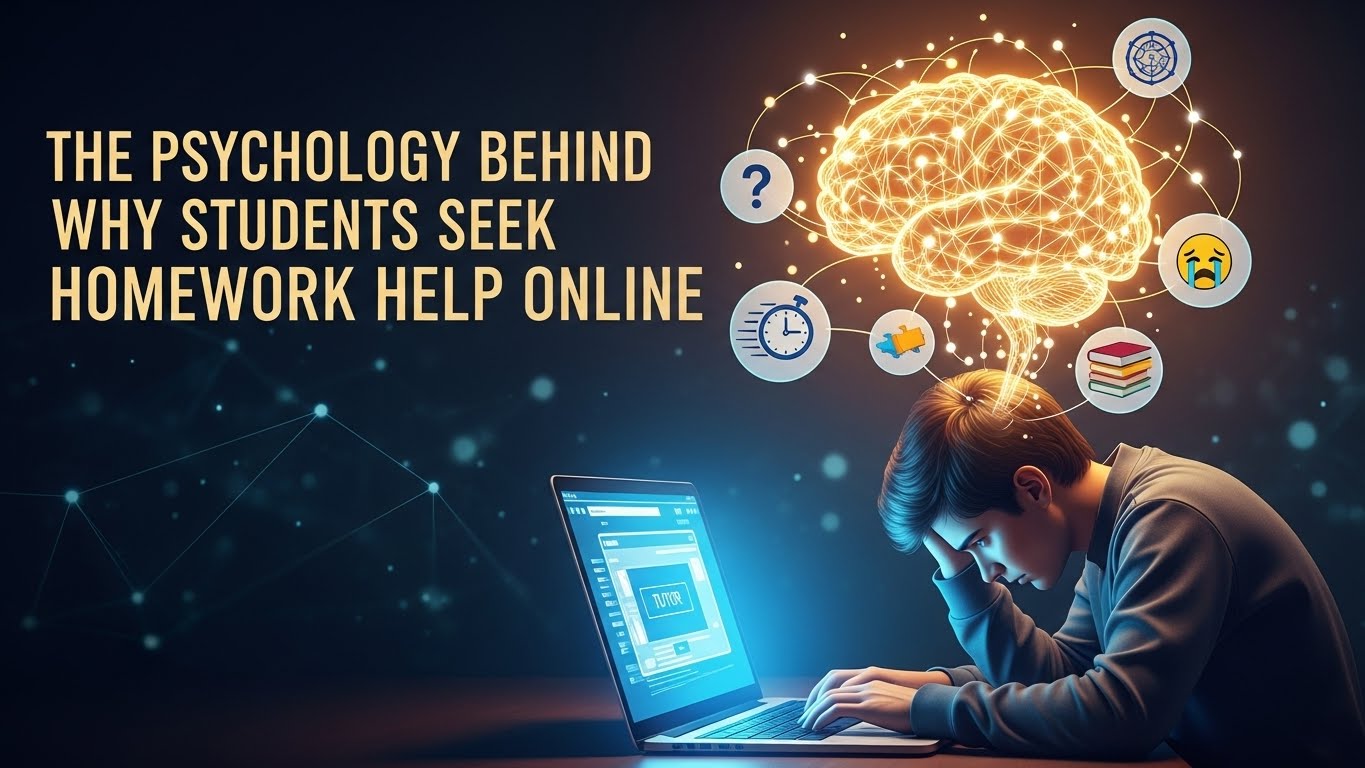
When a student uses an AI homework helper, they aren’t just looking for an answer, they are looking for a way to lower their cortisol levels.
1. The Hidden Weight of Modern Education
Today’s students juggle far more than past generations ever did. Between part-time jobs, extracurriculars, mental health pressures, and the 24/7 noise of social media, there’s a massive amount of “background noise” in a student’s brain.
The modern education system expects excellence at every level: every grade, every project, and every test counts toward a future that feels increasingly competitive.
According to a 2022 report by the American Psychological Association (APA), over 80% of students admitted feeling “frequently stressed” about academic performance.
This isn’t just about the grades; it’s about identity, self-worth, and the constant “comparison culture” that thrives online.
2. The Brain’s “Relief Mechanism”: Overcoming Cognitive Overload
Psychologists often discuss Decision Fatigue, the mental exhaustion that comes from making too many choices in a day. Students face this constantly:
- Should I study math or English first?
- How do I cite this source?
- Is this sentence correct?
When mental fatigue peaks, the brain naturally seeks a “relief mechanism.” Clicking on a smart homework helper tool is often less about “getting out of work” and more about regaining control. It is an emotional coping mechanism that helps students deal with the paralysis of being overwhelmed.
Dr. Carol Dweck, a Stanford psychologist famous for her work on Mindset, once noted:
“The view you adopt for yourself profoundly affects the way you lead your life.”
For a student with a growth mindset, seeking help isn’t a sign of failure; it’s a strategic move to ensure they don’t give up entirely.
3. From Shame to Strategy: The Rise of Cognitive Reframing
In the past, asking for help was sometimes seen as a sign of struggle. But in 2026, that mindset has shifted. Students are realizing that “smart help” is the teammate of hard work, not its enemy.
In psychology, this is called Cognitive Reframing. It’s the act of changing how we interpret a situation to reduce guilt. If a professional writer uses an editor, it’s called “professionalism.”
If a student uses an AI homework helper for students to clarify a physics law, it’s “resourcefulness.” This shift allows students to use digital tools without the weight of academic guilt.
4. The Need for Validation and the “Confidence Loop”
Another strong psychological factor is the need for Validation. Students crave reassurance that they’re on the right track. When a student is stuck, their self-efficacy (the belief in their own ability to succeed) drops.
Many online platforms provide that validation instantly. By seeing a step-by-step breakdown, a student thinks, “Oh, I was actually doing it right; I just missed this one step.”
This creates a “Confidence Loop” where the student feels empowered to try the next problem on their own. In a survey by the EdTech Research Group, 67% of learners said that online help made them feel “less afraid to fail.”
5. The “Comparison Trap” and Social Evaluation Anxiety
Let’s talk about comparison, the silent stressor. Whether it’s LinkedIn internships or Instagram highlights, the fear of falling behind is real. This leads to Social Evaluation Anxiety.
When students feel they aren’t “measuring up” to their peers, they don’t just feel behind; they feel exposed. Turning to an anonymous AI homework helper with no sign-up allows them to fill their knowledge gaps in private.
There is no judgment from a tutor or a peer, which provides a “safe space” to learn at their own pace.
6. Learning Styles and the “Personalization Gap”
The “Personalization Gap” is the distance between how a teacher explains a lesson to 30 people and how you actually absorb information.
- Visual Learners need diagrams.
- Logical Learners need “if/then” sequences.
- Linguistic Learners need descriptive analogies.
Classrooms can’t always cater to this. Online tools fill this gap by allowing students to ask, “Can you explain this again, but simpler?”
This level of control over the learning process is psychologically satisfying and leads to better retention.
7. Technology as an Emotional Buffer
The anonymity of AI acts as an emotional buffer. In psychological terms, this is Reduced Evaluation Apprehension. You aren’t worried about what the AI thinks of you. This freedom allows for a “trial and error” approach that is often missing in high-stakes classroom environments.
As Nelson Mandela famously stated:
“Education is the most powerful weapon which you can use to change the world.”
But a weapon is only useful if you know how to wield it. Online help acts as the “training range” where students can practice without fear.
Ready To Solve Your Homework?
Get instant, accurate answers with our AI Homework Helper tool.
8. The Cautionary Side: Avoiding “Learned Helplessness”
While the benefits are clear, we must address the risk of Learned Helplessness. This happens when a student stops trying to solve problems because they know a tool will do it for them.
The key is Active Engagement. Students should use help to understand the “How,” not just to get the “What.” When used as a guide, technology builds independence. When used as a crutch, it hinders it.
9. Building a Healthy Relationship with Help
Ultimately, seeking help is a reflection of human nature; we are social animals wired to seek connection and ease. The challenge is to do it consciously. A student who balances independent effort with guided support gains something far greater than a grade: they learn Metacognition (thinking about how they think).
Dr. Albert Bandura, a pioneering psychologist, once said:
“People’s beliefs about their abilities have a profound effect on those abilities.”
When students see help as empowerment, they unlock a mindset that sustains lifelong learning.
Final Verdict: Is Seeking Help “Smart”?
Yes. The rise of academic support platforms isn’t a trend; it’s a mirror reflecting the evolving relationship between education and psychology. Behind every “help me” search is a student trying to balance ambition with their mental well-being.
Used wisely, an AI homework helper doesn’t take away the effort, it simply ensures the effort isn’t wasted on frustration. It turns confusion into clarity, chaos into structure, and self-doubt into the confidence to keep going.