How to Use AI for History Homework: A Student Guide
By ADMIN | Updated on: April 2026
History homework has a reputation for being overwhelming. You open your textbook and find 500 pages of dates, dynasties, battles, and revolutions, all presented in language that feels like it was written for someone three degrees ahead of you.
If you have ever stared at a question about the Magna Carta or the causes of World War I and felt completely lost, you are in good company. Most students do not struggle with history because they are bad at it. They struggle because nobody showed them a clear system for making sense of it.
That is where AI comes in. Not as a shortcut, but as a study partner that has absorbed an enormous amount of historical writing and can translate the complicated parts into plain language. This guide shows you exactly how to use it well.
What a History AI Helper Actually Does
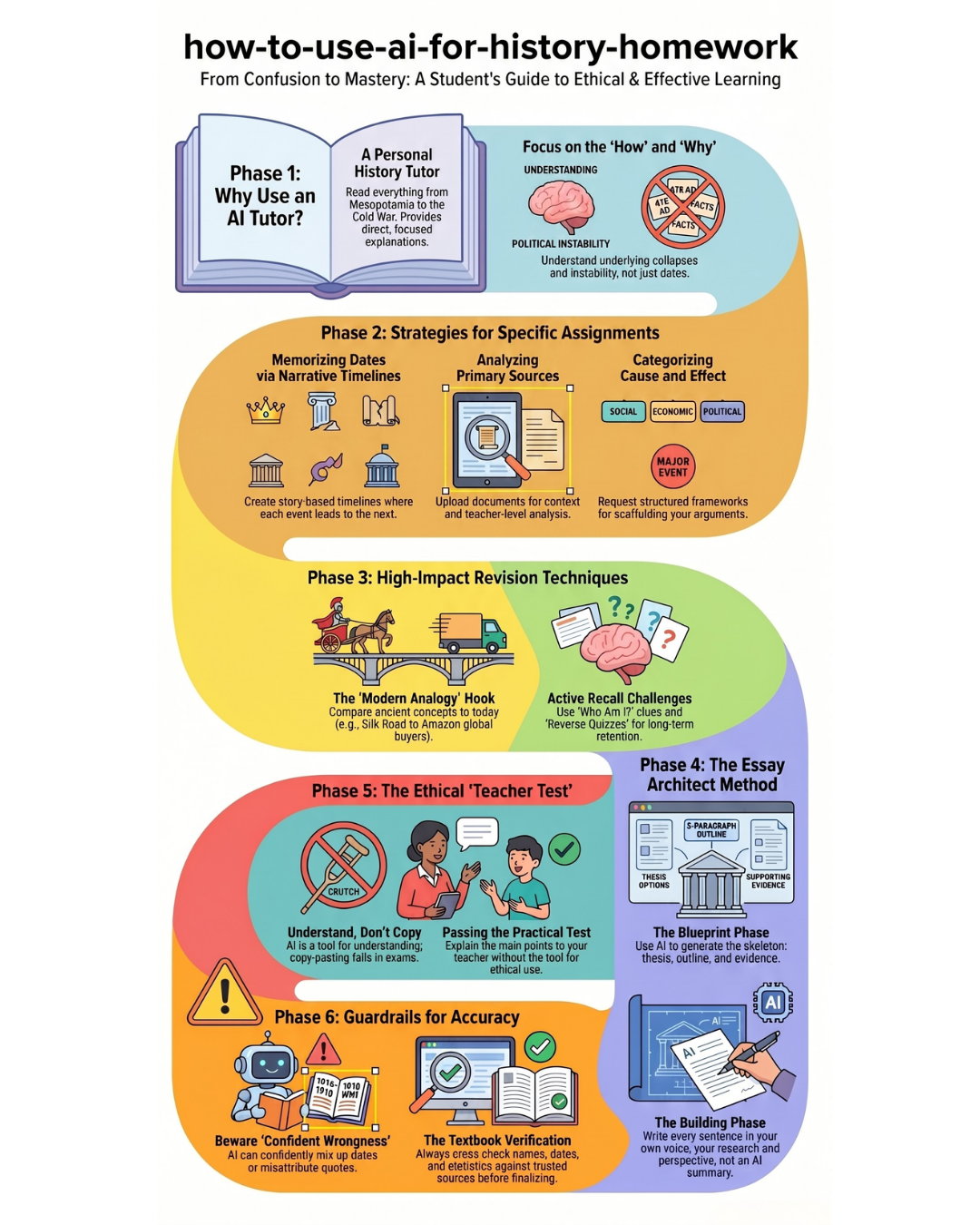
Think of it as a personal tutor who has read everything from ancient Mesopotamia to the Cold War and will answer your exact question in about three seconds. Unlike a Google search that floods you with links, ads, and 20-page Wikipedia articles, an AI helper gives you a direct, focused explanation tailored to what you actually asked.
The key difference between a useful AI tool and an unhelpful one is whether it explains the how and the why, not just the what. Knowing that the Roman Empire fell in 476 AD is trivia. Understanding the economic collapse, military overextension, and political instability that built up over centuries is history. A properly used AI helper teaches you the second version.
For a broader picture of how AI fits into your study workflow, the AI Homework Helper covers multiple subjects and assignment types in one place.
Why Students Are Replacing Google With AI for History
Google is not bad. But it is built for browsing, not for learning. When you are stuck on a specific history question, you do not need seventeen sources. You need one clear, direct explanation. Here is what makes AI better suited for that job:
- Speed without the scroll: You get a focused answer in seconds, not a list of links to wade through.
- It explains the reasoning: AI does not just tell you when the French Revolution started. It walks you through the economic inequality, royal debt, and bread prices that caused it.
- It is available at midnight: Your teacher goes home. The AI does not.
- No registration traps: Many AI tools let you get help without handing over your email or creating an account, which matters when you just need a quick explanation before bed.
How to Use AI for Specific History Assignments
History is not one kind of homework. Depending on your assignment, you will want to use AI differently. Here is a breakdown by task type.
Memorizing Dates and Events
The worst way to memorize history dates is to stare at a list. Your brain is not built for random numbers. It is built for stories.
What to ask: "Can you create a narrative timeline of the five most important events of World War II and explain how each one directly led to the next?"
This turns a set of isolated dates into a chain of cause and effect. When you understand the story connecting the events, the dates stick because they are anchored to something meaningful rather than floating on their own.
Analyzing Primary Sources and Historical Documents
Primary sources like maps, political cartoons, and historical letters appear on almost every history test. The challenge is knowing what to look for when you read them.
What to ask: Describe the document or image in detail, then ask the AI what the key historical context is and what a teacher would most likely want you to identify and analyze.
If your AI tool supports image uploads, you can upload a photo of the primary source directly and ask for a breakdown of what it shows and why it mattered in its historical moment.
Cause and Effect Questions
Most essay questions are cause-and-effect questions dressed up in different language. "What caused the fall of the Roman Empire?" "Why did the Industrial Revolution begin in Britain rather than elsewhere in Europe?" Both of these are asking you to trace a chain of events.
What to ask: "What were the social, economic, and political causes of [event]? Give me a structured breakdown by category."
The AI will return an organized framework that you can use as the skeleton for your own written response. You are not copying the answer. You are using it as scaffolding to build your own argument.
Study Preparation and Revision
AI is genuinely effective as a revision tool in the days before a test. A few specific approaches that work well:
- The Flashcard Method: Ask the AI to give you ten "Who Am I?" clues for key figures from a specific period. You guess the historical figure from the clues alone. This turns passive reading into an active guessing game, and your brain retains information far better when you are actively retrieving it.
- The Modern Analogy: If an ancient concept is not clicking, ask the AI to compare it to something from today. "Explain the Silk Road but compare it to how Amazon connects buyers and sellers across long distances." That kind of real-world anchor makes abstract history concrete.
- The Reverse Quiz: Tell the AI: "I am studying the Renaissance. Quiz me on five key artists one at a time. Wait for my answer before telling me if I was right." This technique is called active recall, and it is one of the most well-researched study strategies available for long-term retention.
How to Turn AI Outlines Into Your Own A-Grade Essays
The most common mistake students make is asking an AI to "write my history essay." This approach backfires for two reasons. AI-generated essays often sound generic and get flagged by teachers. More importantly, you learn nothing from them, so when the exam arrives and AI is not available, you are stuck.
A much better approach is to use AI at each stage of the writing process while keeping the actual writing your own.
- Generate a thesis: Ask for two or three thesis statement options based on your prompt. Pick the one that resonates with your thinking and refine it in your own words.
- Build an outline: Ask for a five-paragraph outline for the essay. Review it, adjust it to match your own angle, and use it as a roadmap.
- Find supporting evidence: Ask for three specific historical facts or events that support each main point. Cross-check these against your textbook before using them.
- Write the essay yourself: Use the outline and the facts you have collected, but write every sentence in your own voice. The essay should sound like you, not like a summary of someone else's research.
This method treats the AI as the architect who sketches the blueprint, while you do the building. The result is a paper that is structurally strong and genuinely yours. For a more detailed breakdown of how to structure history essays and outlines, the guide on what a historical outline actually is and how to build one covers the full process step by step.
Got a Specific History Question Right Now?
Type in your question, upload a primary source, or paste in your essay prompt and get a clear, step-by-step explanation built for history students.
Try the History AI SolverThe Honest Answer: Is Using AI Cheating?
This question comes up every time someone discovers AI, so let's address it directly. The answer depends entirely on how you use it.
Think about a calculator in a math class. If you punch buttons without understanding what addition means, you are not learning anything. But if you use it to check your work after you have already understood the concept, it is a tool that makes you more accurate and efficient. AI works the same way in history.
Using AI is fine when you:
- Use it to understand a concept you missed or found confusing in class.
- Use it to verify a date or fact you are unsure about.
- Use it to create a study guide or quiz yourself before a test.
- Use it to plan an essay outline that you then write yourself.
Using AI crosses the line when you:
- Copy and paste an AI response directly into your assignment without reading it.
- Submit AI-generated writing as your own without engaging with the content at all.
The practical test is simple: after using AI to help with an assignment, could you explain the main points to your teacher if they asked? If yes, you have used it well. If no, you have used it as a crutch, and that will show up clearly when you sit a history exam without any access to AI.
How AI Compares to Your Other Study Resources
| Resource | Speed | Depth of Explanation | Cost |
|---|---|---|---|
| Textbooks | Slow | High (but dense) | Free from school |
| Google Search | Medium | Variable | Free (with ads) |
| Human Tutors | Slow (scheduling) | Very High | Expensive |
| AI History Helper | Instant | High (and adjustable) | Free |
The standout column is depth of explanation. A good AI tool adjusts how it explains something based on what you ask. Ask for a simple version and it talks to you as if you are in middle school. Ask for a detailed version and it gives you the layered analysis you would find in a university lecture. That flexibility is something a textbook or a search result simply cannot offer.
A Note on AI Accuracy in History
AI tools are trained on large amounts of text and are generally accurate on well-documented historical topics. But they are not perfect. They can occasionally mix up dates, misattribute quotes, or fill in gaps with plausible-sounding but incorrect details. This is sometimes called confident wrongness, and AI does it too.
The practical rule: use AI to understand concepts and build frameworks, then verify any specific dates, names, or statistics against your textbook or a trusted source before putting them in your essay. Treat the AI like a very well-read study partner who sometimes misremembers the details but usually has the right general idea.
Frequently Asked Questions
Is using AI for history homework considered cheating?
Using AI to understand a concept, create a study outline, or verify a fact is not cheating. It becomes an academic integrity issue when you copy an AI-generated answer and submit it as your own work without engaging with the content.
What types of history tasks can AI help with?
AI is useful for explaining cause-and-effect relationships, building narrative timelines, outlining essays, quizzing you on key figures and events, and helping you interpret primary sources like maps and historical documents.
How should I prompt an AI for history homework?
Be specific. Instead of "what caused World War I," try "What were the social, political, and economic causes of World War I and how did each one build on the others?" The more context you provide, the more targeted and useful the response.
Can AI help me write a history essay?
AI works best as an essay planning tool. Ask it for a thesis idea, a five-paragraph outline, and supporting evidence for each point. Then write the essay yourself in your own voice, using the outline as your roadmap.
Is AI accurate for historical information?
AI is reliable for well-documented historical topics but can occasionally produce inaccurate details on niche subjects. Always cross-check specific dates, names, and statistics against your textbook or a trusted source before including them in your work.