How to Solve Geography Homework Using AI: A Step-by-Step Guide
By ADMIN | Updated on: June 2026
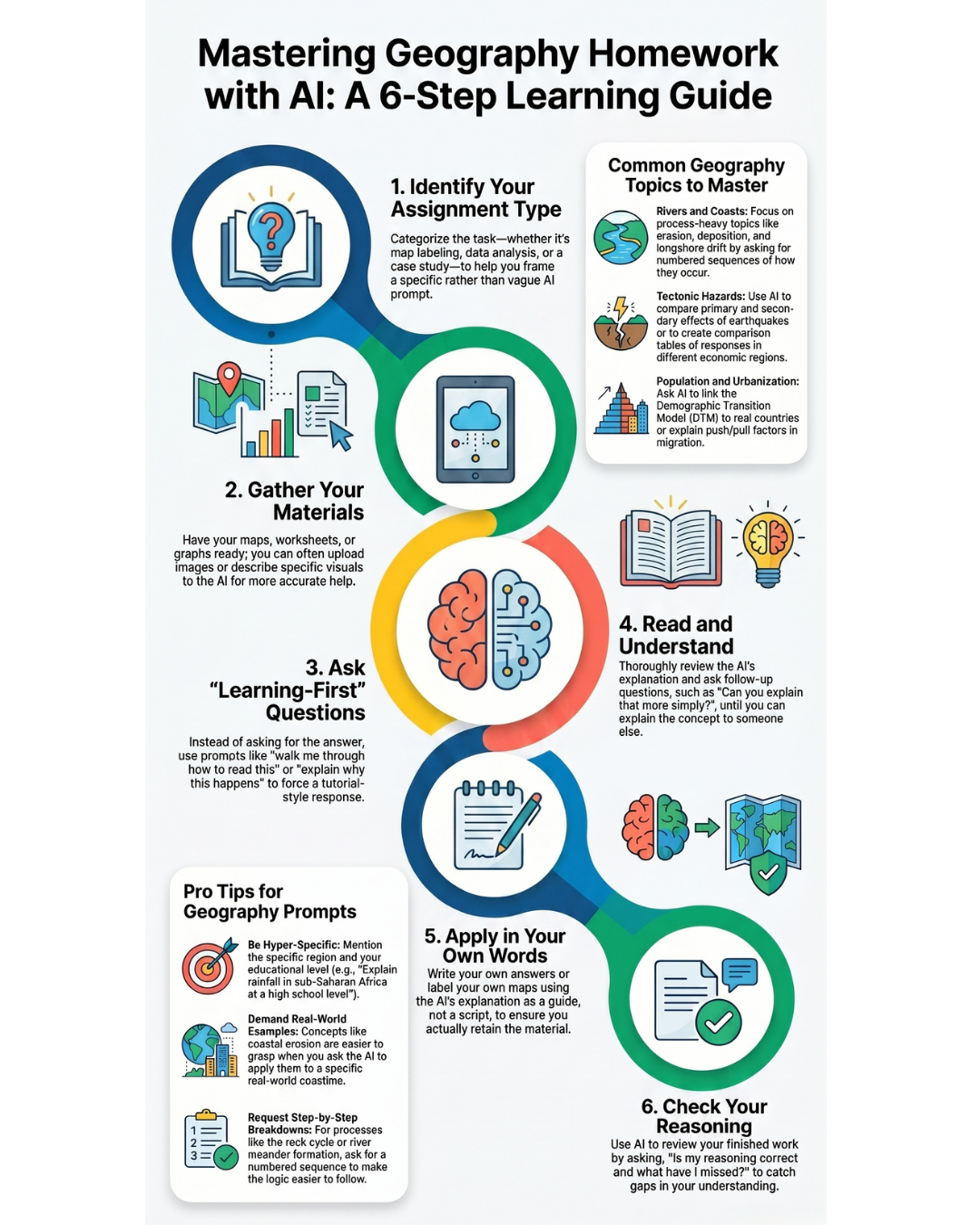
Geography homework covers an enormous range of tasks: labeling maps, analyzing climate data, writing essays about population growth, or explaining how tectonic plates move. The challenge is not just finding the right answer; it is understanding why that answer is correct.
AI tools have changed how students approach these tasks. When used properly, AI does not just hand you an answer, it walks you through the reasoning, explains the geography behind it, and helps you actually learn the material. This guide shows you exactly how to do that.
What Makes Geography Homework Difficult?
Before jumping into AI tools, it helps to understand why geography assignments trip students up. Geography is not one subject, it is several layered on top of each other:
- Physical geography: Rivers, mountain ranges, weather systems, plate tectonics, soil types, and natural disasters.
- Human geography: Population distribution, urbanization, migration patterns, cultural regions, and economic activity.
- Environmental geography: Climate change, deforestation, desertification, and how human activity reshapes physical landscapes.
- Cartography and spatial thinking: Reading and interpreting maps, coordinates, scale, and map projections.
- Data interpretation: Population pyramids, climate graphs, choropleth maps, and statistical tables.
Each of these areas demands a different skill. A student who understands physical geography well may struggle with interpreting a population pyramid. An AI tool bridges these gaps by responding to exactly what you need in the moment.
Step-by-Step: How to Solve Geography Homework with AI
Step 1: Identify What Type of Assignment You Have
Before you open any tool, read the question carefully and categorize it. Is this a map task? A data analysis question? A short answer? An essay? A case study on a specific region?
Knowing the assignment type helps you frame your AI question correctly. A vague prompt like "explain geography" will get a vague response. A specific prompt gets a specific, useful answer.
Step 2: Gather Your Materials First
If the homework involves a specific map, worksheet, graph, or textbook extract, have it in front of you before you start. Many AI tools let you describe what you see, or even upload an image, so the tool can respond to your actual assignment rather than a generic version of it.
Step 3: Ask AI the Right Kind of Question
This is where most students go wrong. Instead of asking "what is the answer to this question," ask in a way that forces understanding:
- "Explain why coastal erosion happens, then show me how that applies to this specific coastline question."
- "Walk me through how to read a population pyramid step by step."
- "What are the push and pull factors in migration? Use an example from East Africa."
- "I have to label the major rivers of South America. Which rivers should I know and where do they flow?"
Notice the pattern: each question asks for an explanation or a process, not just a fact. This forces the AI to teach you, not just give you an answer to copy.
Step 4: Read and Understand the Response Before Using It
Once you receive an AI explanation, do not skip to the answer. Read the full response. If something is unclear, ask a follow-up: "Can you explain the second point more simply?" or "Give me a real-world example of that."
The goal is to reach the point where you could explain the concept to someone else without looking at the screen. That means you have actually learned it.
Step 5: Apply What You Have Learned to Your Own Work
Now write your answers, label your map, or draft your essay in your own words. Use the AI explanation as a guide, not a script. Your teacher will immediately notice if you paste an AI response word for word, and more importantly, you will not retain anything useful for the test.
Step 6: Check Your Work
Once you have completed the assignment yourself, you can ask AI to review your reasoning: "Here is my answer to this geography question, is my reasoning correct? What have I missed?" This turns AI into a checking tool rather than a shortcut, which is the most academically honest and genuinely useful way to use it.
Want AI to Walk You Through Your Geography Assignment?
Upload your worksheet, type your question, or describe your map task, and get a clear, step-by-step explanation from an AI tool built specifically for geography students.
Open the AI Geography ToolHow AI Handles Different Types of Geography Assignments
Map Labeling and Identification Tasks
These are among the most common geography assignments. AI can help you learn the locations systematically rather than just memorizing them:
- Ask AI to group countries or features by region: "What are the countries of West Africa and what are their capitals?"
- Ask for memory tips: "What is a good way to remember the major rivers of Europe?"
- Ask AI to describe where something is relative to what you already know: "Where is Mozambique relative to South Africa and Tanzania?"
Data Interpretation, Climate Graphs, Population Pyramids, Choropleth Maps
These tasks require you to read a graph and explain what it means. AI can teach you the method:
- "Explain how to read a population pyramid and what each age group tells you about a country's development."
- "How do I interpret a climate graph? What do the bars and line represent?"
- "What does a choropleth map show and how do I identify patterns in the color shading?"
Once you understand the method from AI, apply it to the specific graph in your homework. You are learning a transferable skill, not just answering one question.
Short Answer and Explanation Questions
Questions like "Explain why the Amazon rainforest is important" or "Describe the water cycle" require you to write accurate, organized answers. Use AI to:
- Understand the concept fully before writing
- Identify the key points your teacher is likely looking for
- Check that your answer covers the main ideas after you have written it
Geography Essays and Extended Writing
For longer essays, AI is most useful at the planning stage. Ask it to help you structure your argument:
- "I need to write an essay on the causes of urbanization in developing countries. What are the main points I should cover?"
- "What evidence could I include to support the argument that climate change worsens flooding in low-lying regions?"
Then write the essay yourself. Use AI to check your structure and reasoning once you have a draft, not to generate the essay for you.
Case Studies
Geography exams often require detailed knowledge of specific case study locations, a river management scheme, a megacity, a natural disaster, or a development project. AI can help you learn the key facts and their significance:
- "What are the key facts about the Boscastle flooding case study? Include causes, effects, and responses."
- "Explain the challenges of managing rapid urbanization in Lagos, Nigeria."
How to Write Effective AI Prompts for Geography
The quality of the answer you get depends almost entirely on how well you write your question. Here are the principles that make geography prompts work:
Be Specific About the Topic and Level
Instead of: "Explain climate change."
Try: "Explain how climate change affects rainfall patterns in sub-Saharan Africa, at a GCSE level."
Mention the Assignment Format
Instead of: "Tell me about tectonic plates."
Try: "I need to answer a 6-mark exam question: 'Explain the effects of tectonic activity on people.' What should my answer include?"
Ask for Examples
Geography concepts become much easier to understand when tied to real places. Always ask: "Can you give a real-world example of that?"
Ask AI to Explain in Simpler Terms
If the first response is too complex: "Explain that more simply, as if you were talking to a 14-year-old."
Ask for a Step-by-Step Breakdown
For processes like the rock cycle, water cycle, or formation of a river meander: "Explain this as a numbered sequence of steps."
What AI Can and Cannot Do for Geography Homework
Understanding the limits of AI tools helps you use them more effectively and responsibly.
What AI Does Well
- Explaining concepts clearly and at any level of complexity
- Summarizing large amounts of geographic information
- Teaching you how to read and interpret geographic data
- Generating essay plans and identifying the key arguments
- Reviewing your written answers for gaps in reasoning
- Helping you memorize locations through structured lists and mnemonics
Where You Still Need to Do the Work
- Map drawing and labeling: AI cannot draw on your physical map, you have to place the labels yourself based on what you have learned.
- Reading the specific graph in your worksheet: AI can teach you the method, but it cannot see your exact graph unless you upload it or describe it in detail.
- Final essay writing: AI can plan and review, but your teacher expects your voice and your analysis.
- Fieldwork and local geography tasks: AI has no knowledge of your local area unless you describe it.
Common Geography Topics and How to Approach Each One
Rivers and Coasts
These topics are process-heavy, erosion, deposition, transportation, longshore drift. Ask AI to explain each process as a numbered sequence, then ask for a real river or coastline example. Understanding the process makes it much easier to answer any question about specific rivers or coastal features.
Tectonic Hazards, Earthquakes and Volcanoes
Focus on: how plate boundaries work, what happens at each type of boundary, the difference between primary and secondary effects, and how different countries manage the risk. AI can generate a clear comparison table of earthquake responses in wealthy vs. less wealthy countries,a common exam question.
Weather and Climate
Use AI to understand climate zones, what causes different weather systems, and how to read climate data. Ask for examples of how specific weather events affected real places, this is the kind of detail that turns a basic answer into a high-scoring one.
Population and Urbanization
Understand the Demographic Transition Model, push/pull factors in migration, and the challenges of managing both rapid urban growth and population decline. AI can explain each stage of the DTM clearly and link it to real countries.
Development and Global Inequality
Know how to use development indicators (HDI, GNI per capita, literacy rate, infant mortality). AI can explain what each indicator measures and its limitations, exactly what you need for evaluation marks in extended answers.
Climate Change and Sustainability
For this topic, focus on: causes (natural vs. human), effects at local and global scale, and both mitigation and adaptation strategies. Ask AI to structure these into a clear framework before you write any essay or exam answer.
Building Long-Term Geography Skills with AI
The biggest mistake students make is using AI only when they are stuck on a specific question and forgetting about it the rest of the time. Used consistently and correctly, AI can help you build genuine geography skills over a semester:
Review Each Topic After Class
After a geography lesson, spend five minutes asking AI: "Summarize the key points about [today's topic] in bullet points." This reinforces what you just learned while it is still fresh.
Practice Explaining Concepts Back
Ask AI to quiz you: "Ask me five questions about the water cycle and tell me if my answers are correct." Active recall, testing yourself, is one of the most effective study techniques.
Use AI to Understand Mark Schemes
For exam preparation, ask AI: "What does a top-mark answer to this geography question look like? What are the key terms and arguments I need to include?" This teaches you how your teacher thinks when marking.
Connect Topics Together
Geography is full of connections, climate affects agriculture, agriculture affects population, population affects urbanization. Ask AI to show you these links: "How does climate change connect to issues of food security and migration?" Seeing the bigger picture makes individual topics much easier to remember.
A Note on Academic Integrity
Using AI to understand and learn geography is entirely appropriate. Using AI to generate an answer that you submit as your own work without understanding it is not.
The practical test is simple: after using AI to help with an assignment, could you explain your answer to your teacher if they asked you about it? If yes, you have used AI as a learning tool. If no, you have used it as a shortcut, and shortcuts do not help you when you sit a geography exam without AI access.
The students who get the most out of AI tools are those who use them to understand more, not to do less.