Does AI Homework Help You Learn? What 2026 Research Shows
By ADMIN | Updated on: September 2026
Short answer: it depends on what you ask AI to do.
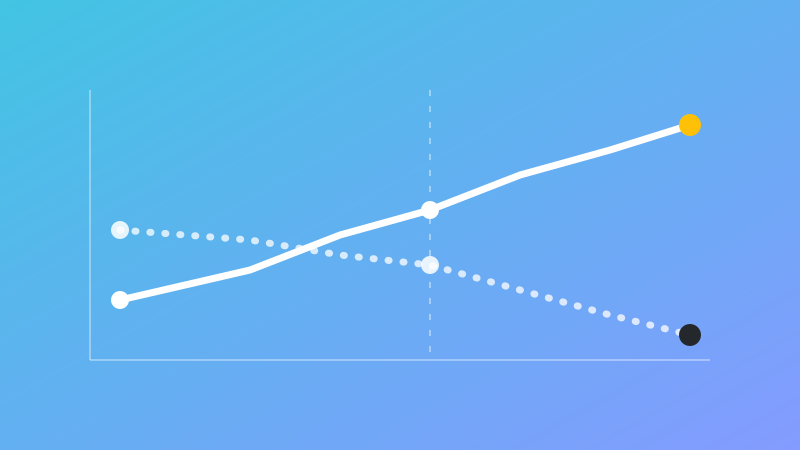
A new 2026 study that tracked about 27,000 students for two and a half years found homework scores went up after they started using AI, but their exam scores went down. The gap between those two numbers is the whole story, and it comes down to whether you use AI to understand your work or to skip it.
This guide walks through what the research actually found, why the gap happens, and how to use AI Homework Helper so your grades and your understanding move in the same direction.
What the New Study Actually Found
The research, reported by Al Jazeera on September 2, 2026, followed roughly 27,000 students ages 12 to 18 for 30 months. Researchers tracked homework scores, monthly closed-book exams, and high-stakes entrance exams across nine subjects.
After students started using AI for homework, their homework scores rose 18%, and the average time spent per assignment dropped from 64 minutes to 45 minutes, about 30% faster. That part sounds like a win.
But within six months, exam scores fell 20%, and entrance exam performance dropped too. The students were finishing homework faster and scoring higher on it, while learning less of the material it was supposed to teach.
Why Faster Homework Can Mean Weaker Exams
The OECD's 2026 Digital Education Outlook offers the clearest explanation. When AI is used without any structure, like pasting in a problem and copying the answer, it found that "outsourcing tasks to the model improves performance with no real learning gains."
Researcher Dragan Gasevic calls this pattern "metacognitive laziness": your brain quietly stops doing the mental work, like recalling facts and checking your own reasoning, that actually builds long-term understanding.
Homework is supposed to be practice. If AI does the practice for you, the homework grade looks fine, but the exam a few weeks later has no AI sitting next to you, and the practice you skipped is exactly what you needed.
Not All AI Use Is the Same
A 2026 Ipsos survey of 7,000 students ages 12 to 17 across seven European countries, done for the Vodafone Foundation, broke down exactly how students use AI for schoolwork. The split matters more than the raw usage number.
- 56% used AI to look up information — a research habit, similar to using a search engine or an encyclopedia.
- 45% asked AI to explain a concept — this is the closest use case to what a tutor does, and it supports real understanding.
- 31% used AI to get a complete answer to turn in as their own work — this is the use pattern most linked to the exam-score drop above.
- Only 20% used AI to build a personalized study plan, a more advanced use most students haven't discovered yet.
The first two uses build skill. The third one trades a short-term grade for a long-term gap, which is exactly what shows up on exam day.
Does This Look the Same in Every Subject?
Not quite. In math, the gap shows up fast: if AI hands you the final number without the steps, you can finish tonight's worksheet but freeze on a test question that uses the same method in a slightly different order.
In science, the risk is copying facts onto a lab report without connecting them to each other, so the concept never becomes a mental model you can apply to a new question.
In writing and history, it's outsourcing the thinking part, the argument or the interpretation, not just the typing.
The fix is the same across subjects: use AI to build the understanding, then produce the final work yourself. Our subject-by-subject guide on how to use AI Homework Helper has specific prompts for math, science, history, and English.
Students Are Using AI More, and Worrying About It More Too
A March 2026 RAND survey of over 1,200 young people found that AI use for homework rose from 48% in May 2025 to 62% in December 2025, driven mostly by middle and high schoolers.
Over that same stretch, the share of students who agreed that "the more students use AI for their schoolwork, the more it will harm their critical thinking skills" jumped to 67%, a rise of more than 10 points in under a year.
Sixty percent said they felt some concern about using AI for school at all, even while continuing to use it.
That's not students being careless. It's students noticing the same gap the research is now confirming, and not always knowing what to do differently.
The RAND survey also found most students don't consider looking things up or getting an explanation to be cheating, only getting a direct answer to submit.
How to Use AI Homework Help So It Actually Helps You Learn
Here's the version of all this research you can actually use tonight, on real homework.
Ask for the reasoning, not the result
Instead of typing a bare problem into AI Homework Helper, ask it to walk through the steps and explain why each one works. For math specifically, the AI Math Solver is built to show its work, not just hand back a number.
Do a five-minute close-the-tab test
After AI explains something, close the tab and say the answer out loud in your own words, no notes. If you can, you learned it.
If you can't, you have a finished assignment and an unfinished understanding, and that gap is exactly what showed up as the 20% exam drop in the research above.
Use it to quiz yourself, not just to answer you
Ask AI to test you instead of teach you: "Quiz me on this chapter, one question at a time, and tell me if I'm wrong before giving the answer." This is called active recall, and it's one of the best-supported study techniques there is.
Premium tools like Quiz Me and Flashcards are built around this exact idea if you want it automated.
Save the time AI gives you, don't spend it on more shortcuts
If AI cuts your homework time by a third, like it did in the research above, use that time to review your notes or get ahead, not to rush through the next assignment the same way.
Speed is only a win if you spend it on more learning, not more shortcuts.
What This Means If You're a Parent
You don't need to watch every keystroke to know if AI is helping or hurting. Ask your kid to explain, in their own words, one thing they learned from tonight's homework. If they can walk you through it without opening the app again, the AI was a tutor.
If they can't, it was a shortcut, and that's worth a quick conversation before the next exam, not a punishment.
It also helps to know that most of the current wave of school AI policies, including the restrictions making news this fall, target chatbot use during school hours on school devices, not homework done at home.
Check your own district's actual policy rather than assuming a national headline applies to your kid's school.
Where This Crosses Into Cheating
Everything above is a study habit, not an integrity problem. It becomes one the moment you copy AI-generated text or a finished answer and submit it as your own without understanding it. That's true whether the subject is math, science, or an essay.
Most schools now use AI detection tools, and beyond the risk of getting flagged, an answer you didn't actually work through teaches you nothing before the exam.
For a full breakdown of where the line actually is, see our guide on whether using AI for homework is cheating.
A Quick Checklist Before You Submit
Run through these four questions before you turn in AI-assisted homework. They take less time than the assignment itself.
- Did I ask for the reasoning, or just the answer? If you only asked for the answer, go back and ask why it's correct.
- Can I explain this out loud, right now, without the tab open? If not, you have a finished assignment and an unfinished understanding.
- Did I check any facts, dates, or formulas AI gave me? AI can sound confident and still be wrong on specific details.
- Is what I'm submitting in my own words? Rewriting an explanation yourself is what actually makes it stick, and it's what keeps you clearly on the right side of your school's academic integrity policy.
None of this takes long. It's the difference between homework that raises your grade tonight and homework that also helps you on the exam that's still weeks away.
Frequently Asked Questions
Does using AI for homework actually help you learn?
It depends on how you use it. The 2026 study above found homework scores went up 18% after students started using AI, but exam scores fell 20% within six months. Using AI to look things up or get a concept explained helps you learn.
Using it to get a finished answer does not.
What did the new 2026 research actually find?
Researchers tracked about 27,000 students ages 12 to 18 over 30 months, looking at homework grades, monthly exams, and entrance exams across nine subjects. Homework scores rose and time per assignment dropped by about a third, but exam scores, including entrance exams, fell.
The OECD linked this to "metacognitive laziness," where your brain skips the mental work that builds real understanding.
Is using AI for homework considered cheating?
No. Using AI to understand a concept, check your work, or get unstuck is a normal study habit. It becomes an academic integrity problem when you submit AI-written text as your own without reading or understanding it.
See our full guide on whether using AI for homework is cheating for the details.
Is it bad to use AI for homework every night?
Not automatically. A 2026 survey of 7,000 students found 56% used AI to look up information and 45% used it for concept explanations, both of which support learning.
Only 31% used it to get a complete answer to turn in, and that's the use pattern tied to lower exam scores.
How do I use AI Homework Helper without hurting my grades?
Ask for the steps and the reasoning, not just the final answer. After you get a response, close the tab and explain the answer out loud in your own words. If you can't, you haven't learned it yet, even if the homework is done.
Can using AI too much make you worse at critical thinking?
A 2026 RAND survey found 67% of students ages 12 to 29 now agree AI use for schoolwork can harm critical thinking skills, up over 10 points in under a year, even as AI use for homework rose from 48% to 62% over the same period.
Most students who feel this way keep using AI, they're just more careful about how.