
Let’s be honest: the “AI talk” in schools has shifted. A few years ago, the conversation was about whether AI should exist in classrooms. Today, that ship has sailed.
The real debate now is about how we use it without losing our ability to think for ourselves.
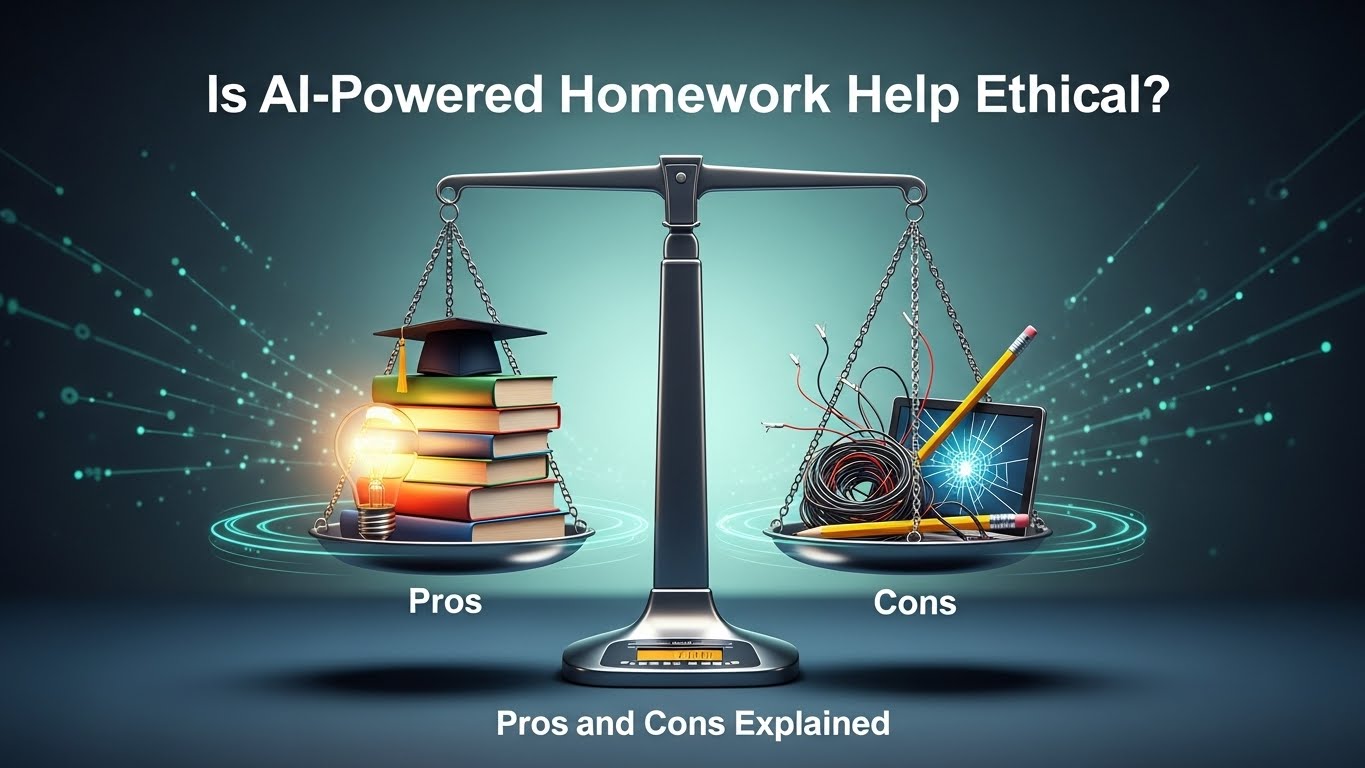
The rise of artificial intelligence has sparked one of the biggest ethical dilemmas in modern history: is it actually fair to use an AI to help with your assignments?
Every night, millions of students sit down with an AI homework helper to bridge the gap between confusion and clarity. But just because the tech is there, does it mean we’re cheating the system or ourselves?
In this guide, we’re going to look at the raw pros and cons of AI in education, the ethical boundaries you shouldn’t cross, and how to use these tools to actually get smarter, not just get finished.
The Landscape of AI in Schools: A Double-Edged Sword
When we talk about the pros and cons of AI in schools, we’re looking at a complete transformation of the learning experience.
A decade ago, if you were stuck on a physics problem at 10:00 PM, you were stuck until the next morning. Now, you have a tutor in your pocket.
The Positive Transformation
On the plus side, AI is the ultimate equalizer. It makes learning accessible for everyone.
- For the Visual Learner: AI can generate diagrams or metaphors that a textbook might skip.
- For the Student with ADHD: It helps break down massive, overwhelming projects into tiny, manageable steps.
- For the Non-Native Speaker: It can simplify complex academic jargon into plain English.
However, the drawbacks are just as real. The biggest fear among educators is the “brain rot” factor—or what psychologists call Learned Helplessness.
If you always ask a machine for the answer, your “mental muscles” for problem-solving start to wither away.
Is AI Good or Bad for Students? (The Intent Factor)
If you ask ten different teachers “Is AI good or bad for education?”, you’ll get ten different answers. The truth is, AI is like a hammer.
You can use a hammer to build a house, or you can use it to break a window. The tool is neutral; the intention is what matters.
When AI is “Good”
AI is a force for good when it empowers you to manage your time and clarify ideas. For example, if you’re using an AI powered homework helper to understand the logic behind a Calculus derivative, you are gaining a skill. You are using the tool to “kindle the flame” of curiosity.
When AI is “Bad”
AI becomes a problem when it encourages a “shortcut culture.” Copying and pasting an AI essay is the academic equivalent of taking a taxi to the finish line of a marathon and claiming a medal.
You didn’t do the running, so you didn’t get the health benefits. In 2026, academic integrity is less about “following rules” and more about “protecting your own growth.”
A Deep Dive: The Pros and Cons of AI in Education
To really understand where we stand, we have to look at the specific trade-offs.
The Pros: Why We Can’t Go Back
- Personalized Learning: No two brains work exactly the same. AI adapts to you. According to a report by UNESCO on AI in Education, AI-driven systems can help bridge the global literacy gap by providing 24/7 tutoring to students who can’t afford private help.
- Instant Feedback: You don’t have to wait a week for a graded paper to realize you didn’t understand Step 2 of a math problem.
- Efficiency: It handles the “busy work” (like formatting a bibliography) so you can focus on the “heavy lifting” (the actual research).
The Cons: The Hidden Costs
- The “Hallucination” Risk: AI can be confidently wrong. It can invent historical dates or scientific facts that sound perfectly plausible.
- Loss of the Human Element: A human teacher knows when you’re having a bad day or when you’re just unmotivated. An AI doesn’t care about your feelings.
- Privacy Concerns: Many free platforms are data-hungry. They trade “free answers” for your personal data. This is why using a no sign-up AI homework helper is critical for maintaining your digital privacy.
Where the Line is Drawn: The Ethics of “The Shortcut”
We have to talk about the cons of AI in education that lead to disciplinary action. In 2026, most universities use advanced “AI Forensics.”
They don’t just look for copied text; they look for “linguistic fingerprints” patterns of writing that are too perfect or too repetitive to be human.
The Problem of Creativity
Relying on AI for creative tasks like writing a poetry analysis or an original short story crosses an ethical line because it robs you of your voice.
You might pass the class, but you’ll struggle in the workplace when your boss asks for an original strategy that an AI hasn’t thought of yet.
The Problem of Inequality
There is also a social ethical issue. If only wealthy students have access to the “best” AI tools, the achievement gap grows wider.
This is why the mission of AIHomeworkHelper.org is so vital—it provides high-level support for free, ensuring everyone has the same “academic weapon” regardless of their bank account.
From the Classroom to the Office: Long-Term Impacts
When we look at the pros and cons of AI in the workplace and education, we’re seeing a preview of the future. In the professional world, “AI Literacy” is a required skill.
- In School: You learn how to prompt the AI and verify its output.
- In the Workplace: You use those same skills to analyze data or automate reports.
However, the “Con” remains the same: if you lose your ability to think critically in school, you’ll be easily replaced by an AI in the office. The most successful people in 2026 are those who use AI as an assistant, not a replacement.
The “Misuse” Trap: How to Avoid Academic Disaster?
The misuse of AI in education usually happens because of stress. A student feels they are out of time, so they take a shortcut. This is almost always a mistake.
- The Grammar Crutch: If you use AI to fix every comma, you never learn the rules. When you’re in a live interview or writing a timed exam, the lack of skill will show.
- The Fact-Checking Failure: Blindly trusting an AI-generated outline can lead to “Fact Hallucinations.”
- The Plagiarism Trap: Even if the AI writes “original” text, if it isn’t your original thought, most institutions consider it a breach of integrity.
For a deeper look at how to avoid these traps, check out our guide on how to do homework better.
Finding the “Golden Mean”: Ethical AI Use
So, how do you use an homework helper without losing your soul or your degree? It comes down to a few simple rules:
- Treat it like a Tutor: Ask it to “Explain this concept like I’m five,” but write the final essay yourself.
- Use it for Brainstorming: Use it to get past “writer’s block” by generating five possible essay titles.
- Use it for Verification: Solve the math problem yourself, then ask the AI to check your steps.
According to a study by Stanford’s Graduate School of Education, students who use AI as a “conversational partner” to test their ideas show significantly higher retention rates than those who use it to generate answers.
Why AIHomeworkHelper.org is the Ethical Choice
The reason we built aihomeworkhelper.org was to solve the ethical problem. Most tools want to give you an answer and take your data. We wanted to create a tool that focuses on Learning First.
By providing step-by-step explanations, our platform ensures that you actually understand the why behind the answer. We also offer an AI homework helper with no sign-up, which means we respect your privacy as much as your education. We don’t want to do your homework for you; we want to help you master it.
Conclusion: The Future is Balanced
AI-powered homework help is here to stay. It is reshaping education in ways that are both exciting and a little scary. The question of whether it is “ethical” doesn’t have a simple yes or no answer it depends on the person in front of the screen.
If you use AI to bypass the hard work of thinking, you are losing out on the very skills that will make you successful. But if you use it as a supportive tool to clarify confusion, manage stress, and explore new ideas you are simply preparing yourself for a world where humans and AI work together.
The future of learning is a balance: use the tech, but keep your curiosity, your effort, and your integrity at the heart of everything you do.